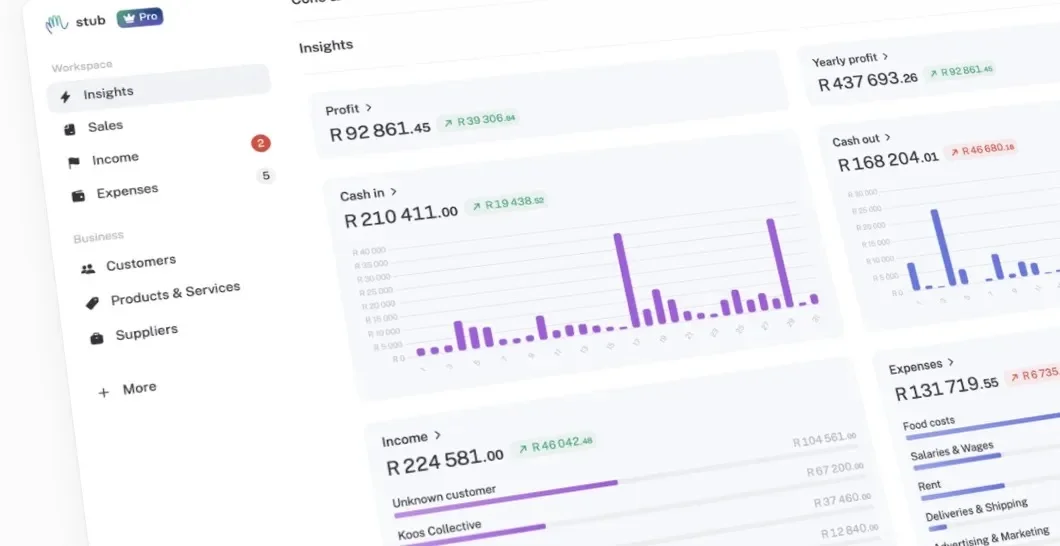
stub, a South African accounting startup founded in 2023, has built what it describes as an AI-native platform for small business accounting. The platform offers tools for sending invoices, managing quotes, tracking payments and monitoring cashflow, built on top of a full double-entry ledger and a customizable chart of accounts.
The company said it increasingly uses automation and data models to categorize transactions, reconcile them against linked bank feeds and surface financial insights, with the goal of reducing the manual bookkeeping work business owners would otherwise have to do themselves.
Tayla Dandridge, co-founder and CEO of stub, told Disrupt Africa, a publication covering African startups, that the idea for the company came from her own career in financial services: "Having spent most of my career in financial services focused on small and micro businesses, I kept seeing the same thing, accounting tools were too complicated, too expensive, and too far removed from how people actually run a business day to day."
Dandridge said existing accounting platforms were not built with stub's target customers in mind: "Traditional accounting platforms are generally built for accountants and established SMEs. They are powerful, but often too complex, time-consuming and costly for a tuck shop, a salon, freelancer or a side hustle." She added that stub's real competition is not other software but informal bookkeeping methods: "It's a spreadsheet, a WhatsApp chat, or a shoebox full of slips. That is the gap we spotted at the bottom of the pyramid: millions of micro-entrepreneurs and small business owners who were completely unserved by traditional accounting software."
stub bootstrapped a large part of its early growth before bringing in angel investors. Dandridge said three partnerships have mattered most to the company's growth: "iKhokha was our first big partnership – stub powers their iK Accounting product, and that single anchor relationship has driven a significant number of businesses onto our platform. The second was our direct integration with Capitec, South Africa's largest bank by customer numbers, which puts simple accounting in the hands of a huge base of entrepreneurs and side-hustlers. And most recently, our direct app integration with Yoco, the payment platform for independent business owners across the country."
Dandridge said the progression from a single anchor partnership to a direct bank integration to working with Yoco took roughly 18 months, a timeline she said she is proud of. She pointed to what she sees as the most significant outcome: "But the most exciting part is the access this creates for entrepreneurs who have never had this level of tooling to run their businesses."
Dandridge described the platform's growth in concrete terms: "We're now supporting just under 10,000 businesses on the stub platform, up from under 4,000 entrepreneurs roughly seven months ago. Signups have compounded every quarter – from a few hundred in 2023 to over 1,800 in a single quarter this year."
stub's strongest customer concentrations are in Cape Town, Johannesburg, Pretoria and Durban. Its customer base skews toward micro and informal businesses, including tuck shops, spazas, taverns, fast food outlets, salons, cafés, independent consultants and service-based entrepreneurs.
Dandridge connected the company's name to its target market and growth approach: "Our name is a statement of intent: stub is built for entrepreneurs. Platforms make global expansion a simpler task, and the playbook stays the same, simple tools distributed through partners and our own direct-to-consumer, on-the-ground channels."
stub operates on a subscription model. Core tools are free to use, with paid plans available for a fuller feature set, and the company layers additional payments revenue on top through payment links.
Dandridge said the company has faced its share of difficulties, which she described as carrying opportunity inside them: "An unhappy customer is often one of the best teachers; almost every time, they are pointing at something that makes the product better for everyone else. And there's also a handful of hard "no"s along the way – and more often than not, that pushes us toward something exciting just around the corner." She added: "So, we try not to treat the hard moments as setbacks. They've shaped the product, the team, and how we show up for entrepreneurs – who, after all, deal with this kind of stuff every single day."