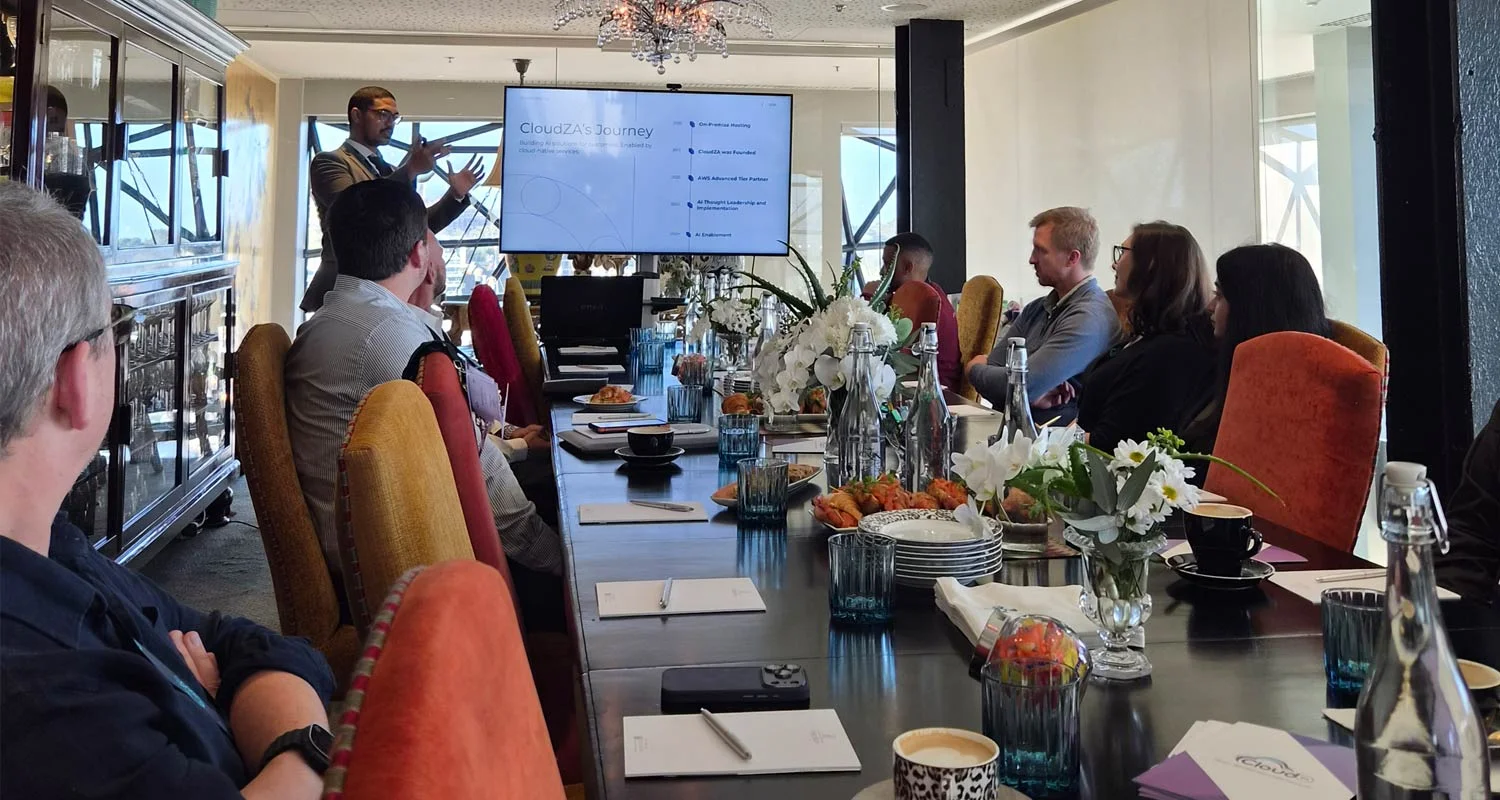
CloudZA, an AWS Advanced Tier Services Partner with more than 15 years of experience in hosting, data storage and server environments and AWS designations in generative AI and agentic AI, co-hosted a closed-door AI executive roundtable with Amazon Web Services, the cloud computing division of Amazon. CloudZA has also won a GenAI Award for an AI-powered statement of work engine it built.
The session brought together South African enterprise and technology leaders, including heads of AI, CEOs, CIOs, CTOs and heads of innovation, to discuss what the companies described as the defining technical challenge of 2026: moving from isolated, chat-based AI pilots to production-ready data architectures capable of running autonomous agentic AI at enterprise scale.
According to CloudZA, the discussion opened by identifying enterprise data fragmentation as the central obstacle. Data remains spread across legacy silos, the company said, which limits the real-time visibility and data orchestration that engineering teams need to scale AI systems, while outdated infrastructure introduces performance bottlenecks, limits scalability and creates security vulnerabilities.
CloudZA presented a four-layer architecture it uses for scaling generative AI. The data layer unifies data lakes, data warehouses and databases into a single source of truth. The platform layer draws on cloud-native machine learning tools and AWS services. The model layer provides access to enterprise-grade foundation models and manages fine-tuning. The application layer covers production decision systems, interfaces, dashboards and autonomous workflows.
CloudZA argued for moving away from rigid extract, transform, load pipelines, known as ETL, toward what it called architectural liquidity, replacing legacy infrastructure with a zero-ETL setup that allows enterprise data to flow into real-time analytics and retrieval-augmented generation, or RAG, workflows.
CloudZA described a four-phase framework for making that transition. An assessment phase evaluates current technical state, resource capacity and structural gaps. A strategy phase designs the target cloud architecture and a migration road map. An implementation phase executes the cloud-native migration. An optimisation phase covers ongoing pipeline tuning and token efficiency.
A central theme of the discussion was the shift from AI copilots that require human input to autonomous agentic systems. CloudZA said agents capable of executing multi-step workflows with limited human oversight can reduce manual administrative work by up to 70 percent while supporting real-time adjustments based on live market data.
CloudZA presented three production case studies from its work with clients. At a South African fintech company, CloudZA used Agentforce, an AI agent product from Salesforce, the enterprise software and CRM company, alongside AWS security guardrails, to address legacy know-your-customer workflows and fragmented data orchestration, reporting 99.9 percent accuracy in technical resolution and processing times that dropped from 30 minutes to real time, a fourfold improvement in speed.
In a fraud detection deployment built on Amazon Bedrock and Amazon SageMaker, CloudZA addressed manual audits of high-volume, multi-document applications. The company said review times fell from four hours to under three minutes per document, with the system processing 722 complex applications simultaneously. The fraud detection pipeline applies a three-layer signal classification approach combining deterministic rules, heuristics and AI scoring to reduce false positives.
A third deployment, focused on quality assurance and built on Amazon Connect, Amazon Bedrock and AWS Transcribe, replaced manual call transcription and compliance scoring. CloudZA reported a 60 percent reduction in QA processing time, a 30 percent increase in agent success rates and a 65 percent rise in customer satisfaction scores.
The roundtable also addressed data governance. Citing a report from IBM, the US-based enterprise technology company, on the cost of data breaches, the session noted that 20 percent of organisations had suffered serious data breaches tied to ungoverned AI use, sometimes referred to as shadow AI, with 65 percent of those breaches involving personally identifiable information and 40 percent compromising intellectual property.
CloudZA outlined its Trust Layer framework, which covers automated compliance monitoring and audit trails, security policies and data-access controls, and automated bias mitigation and hallucination detection. The company said the framework is designed to align with international governance standards including the NIST AI Risk Management Framework, ISO/IEC 42001 and the EU AI Act.
The session closed with an open discussion among attendees covering several recurring friction points in scaling AI deployments. These included whether ingestion infrastructure, schema flexibility or budget breaks first when provisioning real-time RAG pipelines, whether organisations are running explainable AI in production or relying on AI systems to behave predictably without that visibility, how to justify large language model token and inference costs to finance teams against margin gains, and whether prompt engineering is version-controlled with the same rigor as core application code to prevent model drift.