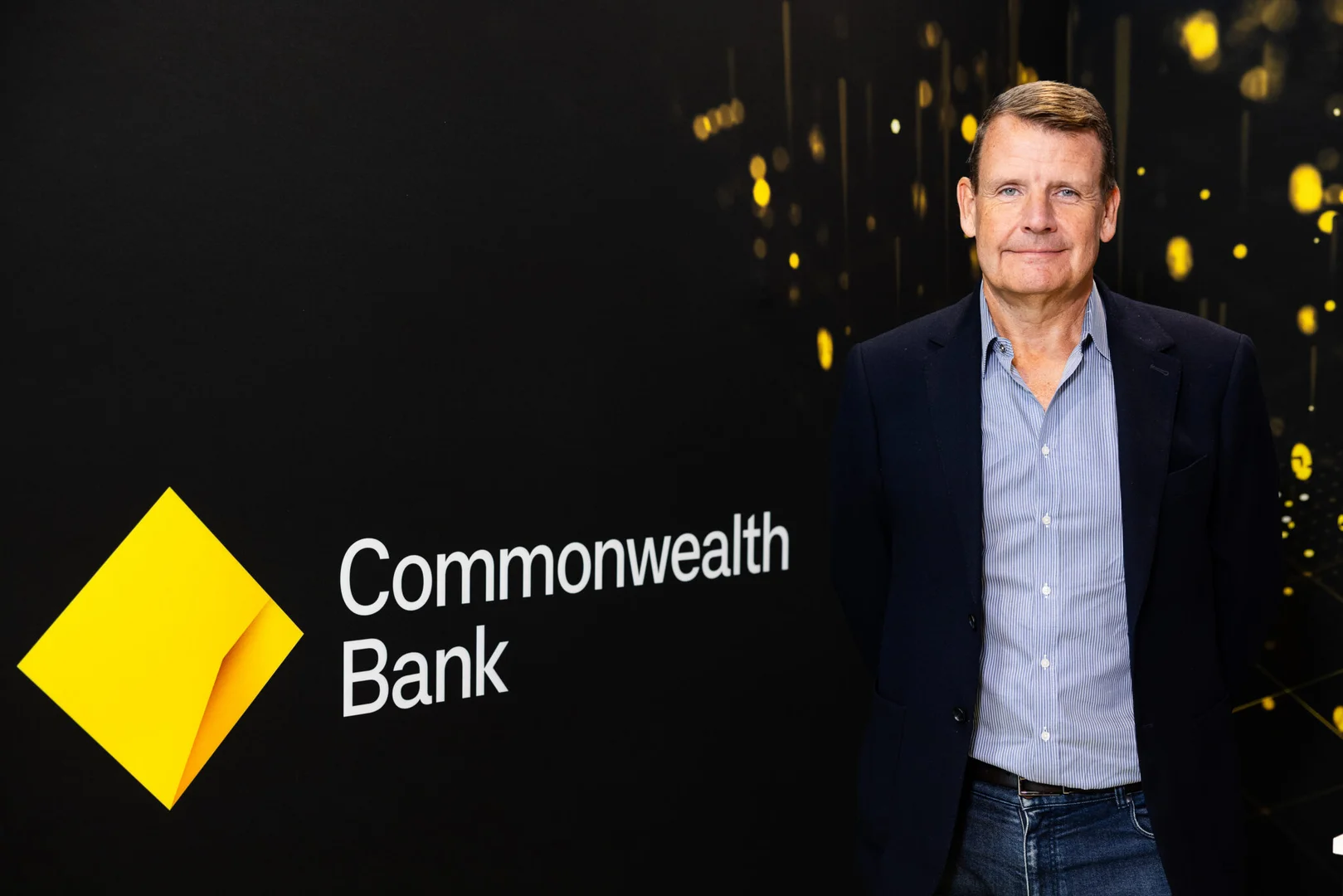
Australia's largest bank by customer scale was running a contact center on a collection of legacy systems that had grown up separately around voice, messaging and digital channels. Each touchpoint carried its own embedded logic, its own data and its own limitations. Martin Lindsay, Executive General Manager of Customer Service Direct at CommBank, wanted to replace the entire architecture with a single AI-powered platform that could handle any customer interaction, from a routine balance enquiry to a fraud dispute, through one orchestrated experience.
The timing became urgent when the bank's existing virtual chatbot reached end of life, forcing a decision about what would replace it. Rather than swap one point solution for another, Lindsay used the moment to reconsider the full contact center environment.
"That prompted us to take a more holistic look at our contact center environment and understand how it could be more strategic, personalized and consistent," said Rachel Round, who leads the teams responsible for self-service customer capabilities across digital and voice channels at CommBank.
Lindsay brought in Shashank Verma, one of CommBank's engineering leaders, to collaborate with Microsoft's development teams. In early 2024, Verma and his team spent three weeks at Microsoft's headquarters near Seattle, working side by side with Microsoft engineers to validate new AI capabilities against real banking scenarios before committing to the architecture.
The model that emerged from those sessions was built around what Verma calls "separating intelligence from channels." Most contact center AI implementations embed decision logic inside each individual touchpoint, which means every new channel requires its own AI layer and creates fragmented customer experiences across the operation. CommBank and Microsoft built a central AI orchestration agent using Copilot Studio and Microsoft Foundry instead. That agent interprets a customer's intent and routes the conversation to the most appropriate responder, whether a purpose-built conversational AI, a retrieval-augmented generation system drawing on the bank's public-facing content, a deterministic path with compliance guardrails for regulated journeys like fraud disputes, or a human specialist supported by Dynamics 365.
When the conversation transfers to a human, the full interaction context travels with it. An AI assistant continues working alongside the specialist, surfacing conversation summaries and suggested responses in real time.
The principle behind the human handoff was as deliberate as the technical architecture.
"Conversational agents can support part of the customer interaction, but we're intentional about recognizing when to bring in a human, especially for interactions where trust and nuance are important," Round noted. "Where a customer's language indicates vulnerability, we expect a human involved to help them with empathy, problem-solving and deeper support."
After the Seattle validation sessions, Microsoft dispatched engineers from multiple product groups to Sydney, embedding them on-site with CommBank's development team. The joint team was building on emerging AI services while simultaneously keeping a contact center running at 50,000 phone calls per day, a combination that created governance and reliability challenges with no established playbook to follow.
"SaaS platforms can't be black boxes when you run millions of customer interactions," Verma said. "Customers have very low tolerances for failure."
CommBank and Microsoft responded by co-engineering the operational readiness criteria, deployment safeguards and automated escalation paths that would govern the platform in production. Nearly 700 existing chatbot topics were modernized and migrated into Copilot Studio. In November 2024, the bank launched what was then Australia's first generative AI banking chatbot, built on the orchestration layer the joint team had designed to scale into voice bots, multi-agentic workflows and enterprise-wide conversational banking over time.
Results
By May 2026, approximately 84.6 percent of self-service messaging interactions at CommBank were being resolved end-to-end within the messaging channel. The platform handles more than two million conversations every month across voice and messaging.
"We're seeing a step-change in how effectively customer enquiries are being resolved through our digital and messaging channels," Round said. Behind the resolution rate is a change in how frontline specialists work. "Conversations are automatically summarized to help our frontline specialists get up to speed quickly, and they can leverage an AI agent to help surface answers and policies seamlessly."
Lindsay described what the co-engineering model made possible: "What's been achieved reflects the strength of our collaboration with Microsoft and our shared focus on better outcomes for our customers and our people. Together, we've combined CommBank's customer scale and domain expertise with Microsoft's AI and cloud capabilities to build something genuinely new."
What Comes Next
The orchestration layer CommBank built was designed from the outset to extend beyond the current channels. Verma described the next phase of the work: "Conversational experiences from both chat and voice are going to help solve real customer problems in Australia. That's the next scaling challenge."
Lindsay's closing assessment of the project captures both the commercial outcome and the model that produced it: "This is what strong partnership looks like — turning ambition into real, scaled outcomes. The impact is clear: faster, more intuitive, always-on support, and our people are equipped with real-time AI assistance that is helping to transform how they serve our customers."